
English-language version of Luistxo Fernandez's blog
Crazy invented religious beliefs
Inside Scientology: The Story of America’s Most Secretive Religion, by Janet Reitman.
 |
A fascinating subject. The weirdness of Scientology’s believe system is summarized quite briefly, but that’s not the main thing; I have learned more interesting facts reading the book. The atmosphere of control described, the newspeak they use (“religious technology”, “ethics”), and the personalities of the two leaders this cult has known: Hubbard the founder, and current leader David Miscavige, who succeeded astonishingly to gain control of the organisation being barely a 20-year old man.
Under the Banner of Heaven: A Story of Violent Faith: Jon Krakauer
 |
Krakauer's story follows the trail of the perpetrators (the Lafferty brothers) of a horrible crime (mother and child killed by fundamentalist mormon relatives), and from that point, it goes back and forth in history, tracing the history of Mormonism, its "prophet" tradition and the very particular history of polygamy within the cult. Astonishing the similarities between Islam and Mormonism.
Both religions/cults are very much clearly fabrications of a couple of manipulative leaders. Most of the faithful in other religions would agree with that. But, then, the obvious question is: well, they're made up religions but... opposed to WHAT?
Recently, a crime has stunned the main Basque city, Bilbao. A buddhist monk killed (at least) two women. Someone who called himself a Shaolin monk, taught kung-fu and said he had founded a monastery. He has been immediatly branded as a "false" monk, because allegedly he hasn't any certification from China. But, he is false, as opposed to what? He is as false as the Lafferty brothers are false prophets: moreover, I would say that the nature of the Shaolin monk's murders, if anything, point to the a true believer's zeal and illumination.
The Jane Austen Telefilm Club

TV adaptations of Jane Austen novels
Having never read Tolstoi or Dostoyevsky, I decided that at least, I had to knew more about their works, so I wrote a movie watchlist and proceeded. I wrote about in Basque, deciding, at the end, that I prefer Lev to Fiodor.
So, the next step: become an expert in Jane Austen. Without reading her books, that is. It's a sin, I know, particularly unexcusable considering that the translator of Pride and Prejudice into Basque is a friend of mine, Ana I. Morales. I wonder what she would say about this pretence of mine about getting literary-savvy just watching telefilms.
Anyway, I did it, and this is my account. (Disclaimer: I'm adding Amazon links to films and novels, BTW, I'm experimenting with the affiliate program of Amazon, and if any purchase is made, I guess I get a couple of cents: this is not a commercial endeavour, I just want to get insights of the system)
The first two novels of Austen, Sense and Sensibility (1995) and Pride and Prejudice (2005), I assume that these are the best known of them all. They also have the most famous film adaptations of lately.

Keira Knightley as Elizabeth Bennet in the 2005 movie adaptation of Jane Austen's Sense and Sensibility
I found them two very similar but, perhaps, there were less interesting male characters in Sense than in Pride. Maybe Jane Austen learnt in the meantime something more about them? or at least perfectioned her management of male characters? Example of that is Mr. Darcy, probably the most interesting gentleman of all described by Austen. But also the clergyman of Pride, described in his littlenes in such a malicious way.
After those two, I proceeded to download some TV adaptations that I found in BitTorrent.

Source: pics.filmaffinity.com via Luistxo on Pinterest

Mansfield Park (2007, ITV production) was the least interesting of them, in my personal view. One detail of it (also noticeable in some of the other works), how Jane Austen stresses the perfidy of the non-monogamous. In that regard, Austen is as much a conformist and a moralist as the establisment of her time.
In Emma (2009, BBC), the female central character (as always, we suspect some part of Jane is auto-fictionally present in it) shows some flaws that we don't see in other novels: some unwise and somehow mean moves when trying to advice her "lower class" friend Harriet towards a "proper" marriage. Anyway, there's a happy ending at the end, and the classes marry among themselves, lower and upper, each one in their hierarchical position.
Posthumously published Northanger Abbey (2007, ITV) is, apparently, the 1st work Jane Austen wrote, although she didn't see it printed while she was alive. It's meta-literary tone is its most interesting asset, but the abrupt ending is a little bit dissapointing. That happens in most all Austen's stories as well: whatever long it takes to reach a certain point, then it all resolves in a sudden scene, a marriage proposal, and some explanations so all thrills and enigmas are shortly explained in retrospect, and that's it.
Then we have Persuasion (2007, BBC), which looks a little bit as if Jane was pitying herself as her age advances and she doesn't marry. Well, the character in the novel does marry with the right and righteous man, a naval officer, but we know Jane didn't marry.
After watching all these dramas, I did finish my journey with another movie: a modern melodramatic film, The Jane Austen Book Club (2007). It's just a light flick, and the references to Jane Austen don't match that well in the movie, although we get some good lines: "Austen's novels always end when they marry, we know nothing of the aftermath". Yep, that's true.
 Source: 2.bp.blogspot.com via Luistxo on Pinterest |

Anyway, one thing that is shared between this 21st century film and Austen's novels: monogamous marriage is the right thing to aspire for. Frankly, I'm not totally for that, myself being a divorced man of 46 years of age, although I do understand one of the key elements of the Austen novels: the anxiety of the young when trying to find a longtime partner, the aspiration to build your own family, the doubts around one's sentiments, the need for securuty, the limited "set of matches" that one might get during a certain period of years before one loses the chances... I did share some of those anxieties myself and, all in all, I do sympathize in a certain way with the struggles of Jane's fictional women.
Big men of American History

This is a very pro-American and pro-military book, of course, but it doesn't lack criticism about Vietnam or Iraq. I found it quite balanced. In one point, I found it partial, though: in the Vietnam chapters some pages are devoted to the Hue massacre by communist vietnamese forces. Well, that hapenned far from the US general's command, so I don't understand quite the point, particularly if, in the case of the Korea war, nothing is commented about the Bodo league massacres, crimes commited by the allies of the US military, under their noses so to speak. But well, it's worth reading.
The book ends before the latest events relating the highest US military posts: General David Petraeus's marital scandal. So, the author's opinion about that affair in his blog can be like an epilogue to the book.
The other book: Thomas Jefferson - The Art of Power. A biography by Jon Meacham about one of the founding fathers of the United States.

I haven't found this book (and the subject) as interesting as a Benjamin Franklin biography that I also read recently. Jefferson doesn't seem to me such a great man as Franklin. And the way he made a teenage slave a concubine, well, looks much like institutiozanalized rape. Franklin was also a slave owner, but there was nothing in his life like that.
***
Well, from now on, I will write more about books and cultural items that I have read/watched in English. I maintained for some months a Tumblr to cover that, but I decided to end it after 15 months of reviews. Now it is the turn of The English Cemetery again.
Dƶoxar Dudayev and Dzhokhar Tsarnaev
This name, Dzhokhar, has a certain sonority. We've seen it again these days, sadly, a certain Dzhokhar Tsarnaev is one of the responsibles of the Boston Marathon attack. It was written Dƶoxar in Chechen while Chechnya was de facto independent under President Dudayev. I saw it written that way in Chechen, in Tartu, Estonia, in a sign at the Barclay hotel door, while on vacation in 2000.

Dƶoxar Dudayev was commander of a major strategic bomber unit placed in Estonia, at the end of life of the Soviet Union. His troops were ordered to repress the pro-independence democratic in Estonia, but Dudayev refused. An Estonian friend explained this to me there in Tartu that day, as the hotel had been the former headquarters of Dudayev's command post. Estonians highly regarded Dudayev. It was for me an emotional moment, to see this sign, written in a minority language with not much more speakers than Basque though a more minoritised status (we also share an ergative construction), that briefly acquired a more decent and proper status.
In 1991 Dudayev left the Red Army and Estonia, and went to Chechnya to lead the independence project. They succeeded at first, peacefully and democratically, in the first half of the 1990s, and they created the Chechen Republic of Ichkeria. Among other measures, they introduced a Latin alphabet for the Chechen language, replacing the Soviet-era Cyrillic. That's the script at the center of the Tartu plate.
It was also during those years that Dzhokhar Tsarnaev was born. Conceivably, admiration for Dudayev might have influenced the choice of name.
In 1996, Russia decided to intervene militarily, to restore the empire and let no other small nation be free. The first Chechen war, led by Boris Yeltsin, was a disaster for the Russian army was defeated and humiliated. However, it was also bloody and terrible for Chechnya, and among the thousands of victims, its president, Dudayev.
Russia retaliated with more blood and military power in the second Chechen war, led by Vladimir Putin on that occasion. They won, but at what cost: insurgency leading to terrorism, murderous repression, Islamic radicalization of both the resistant groups and the corrupt puppet regime and pro-Russian warlord Ramzan Kadirov (link to his Instagram).
In 1991, Estonia and Dudayev separated, and we know how History has go on. Estonia is a prosperous and modern country, and the euro is their currency. Chechnya is a nightmare of repression and Islam.
What if... in 1991, when Estonia and Dƶoxar Dudayev separated, they had been free to continue the business of politics peacefully? Estonia got that chance, and now it is a prosper tech-savvy republic in the eurozone. Chechnya is a nightmare of repression and Islam. Dƶoxar Dudayev might have lead the country in another direction, should not Russian imperialism impose the war. We can hardly imagine Chechnya in the European Union, but they may have had another destiny, much more peaceful and prosper (and constructive for the international community) than the present status. It wouldn't be Estonia, but I suspect that it would be a very different outcome. Dƶoxar Tsarnaev also would have lived another life, one that probably would not have led to plant bombs on the streets of Boston.
Basque trending topics of Twitter
What is trending in Basque in Twitter? Twitter itself has not the answer. Although in the latest city deployment of Twitter trend locations there is Bilbao there (main Basque city), still it's not a good measure of our community. As a matter of fact, looks like Twitter only treats TT's geographically, not by language. Well, we at our company CodeSyntax built that tool for Basque: Umap.eus, tracking Basque trends, content and users in Twitter.
Umap worked from one year since Nov., 2010, but then it collapsed, because at the time of launch we could detect and track all Basque users of Twitter (1,100 or so at the time), but when we surpassed the 5,000 user mark (the number supported by Twitter's API), the tool was surpassed too.
Well, we rethought Umap, and the new version is based in a ranking of users (with interesting language usage stats, BTW, here you have mine). We've also improved trend detection, although unlike Twitter's TT system, we only track hashtags. We store them in an archive and using Twitter's new improved search options, we link to that moment of the past when a given term was trendy for Basques. So, on april 7th, the top trends in Basque were #tropela and #ParisRoubaix, both related to cycling, and we can link from there towards Twitter.

The joy of BBC
The TV channels that come to my home are not under my control (it's a neighbourgh thing, they distribute some channels by cable, and that's what we get). Last year, I lost Eurosport, and I resented it, but this year, I got BBC One and BBC Two and it feels great. So, the Snooker World Championship that I partially lost when Eurosport faded away from my TV at mid-tournament, will return to my telly with the BBC this year :-)
I enjoy the quality of documentaries, mostly. Watching Penguins was marvelous, I had no idea that in the coastal desert of Peru there leaved sea lions, penguins and vampires all pitched against each other... Another great seriesm Wonders of Life. The smart physicist Brian Cox that guides that show is like a the Richard Attenborough. I think that's the idea of BBC putting him in different shows.

Source: covers.booktopia.com.au via Luistxo on Pinterest

But, of course, Attenborough is well and filming (Africa is his latest series, and we've enjoyed that too).
Not only documentaries, the news hours of BBC are superb. So so far from news reporting as we are accustomed here. Many times it's worth watching the London local news 30 minutes. More informative than Spanish news. I've read today this article about the fight between the BBC and Margaret Thatcher: it makes one wonder about thatcherism. That is so different from Basque or Spanish standards: here, it is a matter of fact that the governing party controls TV to push its own agenda, places their cherished people in command, control the news...
Managing Niagarank, a news aggregator and robot curator
I am currently working at the helm at Niagarank, a new newssite we launched in January for the Spanish market. At CodeSyntax we have developed a robot curator engine that we call Robsoc, and Niagarank is one instance in which Robsoc is working right now. With this technology, we can create automated news channels about any topic, in any language, made from most shared items on Twitter by algorithmically ranked experts.
Niagarank crawls realtime news watching what the people tweets. In 40 distinct channels we have detected and ranked a community of several thousand users, and tracking their tweets in realtime, we also rank the news that sprout out. The curation process is automated and massive. Thousands of links are analyzed, and only a handful are published. For instance, this is one week of activity in one of those channels, Politics.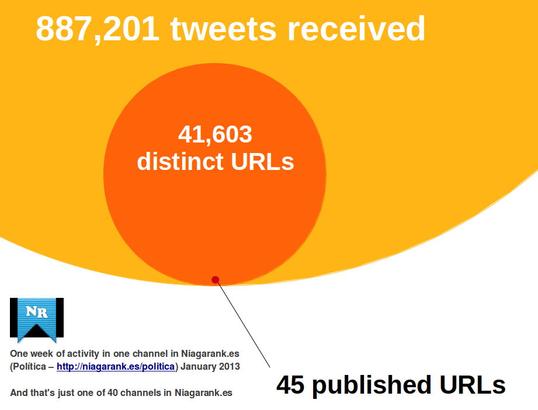
I used that graph at a recent conference I gave at the Master in Digital Journalism at the IE School of Communication, Madrid. Then, they interviewed me for the blog, and here there are those Q&A's:
In your opinion, what is the role of social media in communication field?
LF: All social media play a central role in the realm of communication. Well, Internet itself is pure communication, best invention we could imagine for that human need… Then, introducing one’s social entourage as an enhancer of the communication experience adds nuances to that experience. On one side, you can create your own communication channel selecting your sources (friends or otherwise), but on the other, closed circles can also be created. Your entourage has a certain color or taste, and what you consume, at the end, may end being monocolor…
In Niagarank, Twitter assumes a role in journalism area: people enter in the platform and see the most commented (by consequence, important) subjects of the day. It can be considered as “audience natural edition”. In your opinion, is it a trend that social media also assumes a role in the journalism field?
LF: Social media is a prime informative source for many of us. We get to know relevant news and information through those channels rather than by mainstream media. But at the same time, the amount of noise and irrelevant chatter may be overwhelming. Although Trending Topics in Twitter might be informative, many times they are just a miscelaneous chaos. In Niagarank, on the other hand, we try to refine information, not in terms of Topics, but real news or informative links, and we add up the most relevant tweets to those items, not just the most retweeted, but also the ones that are relevant to that community. And I say community, because we have created distinct channels in Niagarank, and in each one of these channels, we follow a different set of users.
What is special about Twitter?
LF: It is obviously the social networking with biggest connection to the concept of news and information. Therefore, it is the closest to what might be considered media.
On what markets do you see opportunities for Niagarank? Why?
LF: We are trying to build Niagarank.es as a destination newssite in Spain. That is a b2c perspective, trying to reach the audience in general, people that is thirsty for news in this or that subject. But, we also believe in a b2b setting, in which the content-discovery functionality of Niagarank can be put to the service of organizations or businesses which need to develop a content-rich experience for their web or social media strategies. In order to fulfill that objective, they might purchase content, hire content creators… or use the automated machinery of Niagarank, a cost-effective solution.
More about Niagarank in English here. Of course the name is a combination of Niagara (we've built a torrent of news) and Rank (ranking experts and links is what the robot does). Soon we hope to offer more in this language: we launched with a .es domain, but we've got the .com version in preparation :)
Zestapunta.com new online platform to exchange goods, those things that pile up at home
So, here it is Zestapunta.com and this is the interview with Ed Freyfogle that was published in Basque in Sustatu. The following lines are the origin of that text.

Sustatu: What is the idea behind Zesta Punta?
Ed: Zesta Punta is a service designed to help us share things we have but no longer need while also having fun and engaging with friends.
Most people have all kinds of useful stuff sitting in their closet unused - clothes, books, games, videos, tools, etc. that their friends could get a lot of value out of (especially in these difficult economic times). We’re hoping to create a platform that makes it much simpler, more fun, and more rewarding to share things you no longer need or want with those who could get value out of them.
We try to focus on keeping it fun. To do this we use the game analogy. Players earn carrots - our mascot is a rabbit, you can see him in our promo video. You can then spend the carrots to get things from others. One of the key features though is that you can search for things just from your friends that also play, or friends of friends. Sharing with friends is great not just because you’re helping your friend, but also gives you a good excuse to meet up and catch up.
We try to provide a simple overview of how it all works on our “how to play” page.
Why is an American launching a web service in Basque? Do you speak Basque?
Unfortunately my Basque is still very limited (though improving!). For the last 6 years I’ve been working on the property search engine Nestoria together with Javier Etxebeste, who lives in Bilbao. One of the great side benefits of the Nestoria business is that it means I get to come to the Basque country frequently, and have always enjoyed it. It’s a truly unique place and culture, very different than London where I live. As an English speaker, one thing I’m always struck by is the sense of solidarity that using a “small” language like Basque creates. As we watched the financial crisis engulf Spain, Europe and much of the world over the last few years I wondered if the combination of technology and that sense of community might together be an effective tool to help people in these difficult times. Zesta Punta is an experiment to find out.
That being said, we of course don’t want to limit the fun just to Basque speakers, the site is also fully available in Spanish and English.
Why call it Zesta Punta?
(Zesta Punta is one of the names for the sport also known as Jai-Alai) I wanted a name that conveyed the Basque country origins of the service, and I thought the metaphor of throwing things in and getting other things back would work. I know at first it might be confusing because of the mix up with the actual sport, but so far the feedback has been very positive.
There are already second hand services like ebay, why should someone use Zesta Punta?
Ebay is a great service, but frankly it’s not about having fun. Selling something on ebay is a lot of work, usually for not much gain. Using Zesta Punta to share things with your friends is fun and makes your friend happy.
So I’d say the biggest difference is that our focus is on fun and enjoyment.
So how exactly does Zesta Punta work?
Players join the service and start with a few carrots. You can then spend the carrots to get stuff from others. You can earn more carrots by inviting friends, giving away things you no longer need and sending us feedback.
What have you learned in the last two months during the test period?
We’ve had phenomenal feedback and built up a motivated community of several hundred players, mainly women in and around Bilbao, but with a few pockets in Pamplona, Eibar and elsewhere. Many thanks to all of them.
They’ve helped us find a few bugs, but the main learning is that simple is almost always better. People want to have fun with the service, but they really don’t want it to be complicated.

For our more technical readers, what are some of the technologies used to build the service?
Right now it’s mainly built in perl using a framework called Mojolicius with lots of javascript and mysql. On the frontend to develop quickly we’ve use JQuery and Bootstrap and a service called FilePicker which I can highly recommend. Behind the scenes we use AWS and github.
One of the main technologies we use is Facebook’s API. To register with Zesta Punta, you need to do so via Facebook, so we can pull in your identity.
Our goal with this first version of the service was to learn from the users. We think of it as a prototype, not the final thing. As we learn more I’m sure our technology will evolve accordingly. As an example, we know mobile is critical. So far we’ve focused on the mobile web version, but will also be releasing apps soon.
We have started to expose our API, anyone who is interested can see the beginnings here and if you have questions or want to experiment please get in touch.
How can we expect Zesta Punta to develop in the future?
The main thing to expect is that we’ll keep trying to learn from the players. We welcome all feedback (so much so that players earn carrots when they send us feedback).
I invite everyone to sign up and give it a try, we have hundreds of great things (you can browse them here) available for free. Though I don’t speak Basque since I had the chance to speak here in 2006 I’ve followed the growth of sustatu, and I know it’s a lively community that can no doubt give us lots of useful advice on improving the service.
I have one request though, please be patient with us, we’re a small team - there are many new features we want to add, we are getting to them, one by one.
Anyone who wants to stay up to date on Zesta Punta should follow us on twitter (@playzestapunta) or read our blog (in Spanish).
Well... there it is: Zestapunta.com. Good luck!
Post-feminist mad men
I think that feminism's cause is one the great struggles of our age. Issues of gender and sexual-choice freedom are essential, I think, for a more just and viable society. Seeing so much repression, anger, intolerance and violence around those questions is painful.
Still, I don't call myself a feminist man. I think it would be a little bit presumptuous. I'm probably too attached to the burdens of growning up in a heteronornative environment, not freed from my own fears and prejudice, and still occasionally I fall on the sexist cliche or joke (maybe too often). But I want to be a feminist. I try to learn, to correct my missteps. I'm educating myself (and I have found good friendship and advice in that regard), reading authors like Virginie Despentes or Marlene LeGates. And I think that it is an achievable goal, to be a feminist man, and recognize myself as such. I'm confident I will eventually make it :-)
In that learning curve on my own, a new concept that I didn't know: post-feminism. A Basque writer with a post-doc position now in London, Katixa Agirre, instructed me about that, about her work. She's found the issue and studied the subject in a fascinating TV series: Mad Men. Agirre told me: watch it, it's good, but be aware of the post-feminist morale in it (and she briefly described that to me, so I grasped a little bit of it, but not fully, to be true).

Source: Uploaded by user via Luistxo on Pinterest
But now Agirre has published an essay on the question ('Whenever a man takes you to lunch around here': Tracing postfeminist sensibility in Mad Men). A text that will make more sense to you if you have seen at least a couple of Mad Men seasons. The paper brings a clear explanation of that post-feminist concept, the delusional idea that maybe these gender issues have already been corrected in our modern society... The essay is a delicious piece of film-psichology: how she dissects each and everyone of the characters. Mad Men is hypnotic, in a sense, I've felt glued to its narrative season after season (I've watched up to S04), now I have some clues about why that hypnosis happens, and I, even if I think that the next season will be as lustfully adictive as the previous one, I'll open my critical eye, and at the same time watch and enjoy with no remorse. Porn without guilt, of course.

Katixa Agirre, Basque writer.
Localising social experience: it would be nice to showcase Angry Words in Basque at the next SXSW
Angry Words is a very popular Scrabble-like game played over the Internet through Facebook and smartphone and tablet apps (both Apple iOS and Android). Created by an Argentinian company, Etermax, it's also known by its Spanish name, Apalabrados. You can play against friends or, asking for an anonymous player, virtually anyone else with the app. And you can choose the language of the game among various options (12, currently). One of them is Catalan. And recently, in Beta status, Basque has been added. So, you can simultaneously play parallel games against people around the globe in several languages.
(Note: the Basque version is Beta, almost Alpha. Not fully functional in Facebook yet. Lexical and declension options are being discussed, and, bizarrely, the math in the version is wrong: you get points but the addition does not score properly, XD; we're sure these things will be fixed soon, no pressure to Etermax, they've been just great making this possible)
The localisation effort for Basque is due to one person mainly, Maite Goñi, dedicated Basque geek, university teacher and an expert in online learning. She contacted Etermax on her own and asked them, what do you need? They needed words, so she also contacted the people with the right Basque resources, language-promotion body of the Basque government and the university group Ixa, pioneers of Natural Language Processing in Basque.
Because, you know, the set of words at Angry Words is not a plain dictionary, but you need declensions as well (plurals and verb forms are included in the Spanish and English versions). And it happens that declensions in Basque are almost infinite: ours is a postpositional languages in which nouns are flexed with various affixes, also three numbers (singular, plural, indefinete). Verbs also (mainly the multi-personal auxiliary verb system) have lots of forms. (This does not mean Basque is difficult: to the contrary, those multiple forms are very very regular and result from the combination of a limited set of affixes which are not so hard after all).
So, the basic dictionary of Basque had to be declensed to get the variations for each noun, verb, and that's what the IXA team did for Maite. For instance, the dictionary noun Abuztu (august, the month), which in Spanish or English just has two forms (august, augusts, agosto, agostos) can be played like this in Angry Words in Basque:
abuztu abuztua abuztuak abuztuan abuztuarekin abuztuaren abuztuari abuztuaz abuztuei abuztuek abuztuekin abuztuen abuztuetako abuztuetan abuztuko abuztura abuzturako abuzturen abuzturik abuztutan abuztutik abuztuz
And that's just a set of the possible combinations according to case and number... Anyway, some compromise had to be made to limit the number of flexions and the most used ones were chosen. However, the resulting word set is nearly 170.000 items, and yet, players are saying that common words are absent. So, maybe one of the result of the beta-testing phase might be reduce the number of allowed declensions but increase the lexical entries.
One of the fascinating things about this localisation effort is that it's like the perfect example for which I call the menu/food dilemma in tech development for minority languages. Having the menu in your language is fine, but it is content, the food, which really matters (one of the points I stressed in a recent Unesco seminar). For instance, Twitter in Basque (also made available this august) is fine, but the main crucial question is if there's comments, and links, conversations and memes exchanged in our language (it seems that yes, there's an active community).
With Angry Words, as a matter of fact, it doesn't matter the language your interface shows: you can choose the game's language at well. Different games with different people in different languages (being multilingual is nice :-) and all adult Basques are at least bilingual). The interface has also been localised, but unfortunately, due to restrictions by makers and carriers, you can only see it in Basque in some unlocked Android devices. I cannot for instance, change the interface of my Apalabrados / Angry Words from Spanish. Orreaga Aranburu, a friend, could do it in her Galaxy S II:

It is also interesting that the localisation work needed in this case language resources developed throught the last 20 years or so. Lexicons and natural language processing rules for Basque, developed by enthusiasts, academia and public bodies, have been put into use over a distributed online mobile platform, an application hardly imaginable when Basque natural language processing began being pushed in universities in the 1980's. Research and corpus building, therefore, is important, as well as the open availability of those resources.
But for me, which strikes me more about Angry Wors in Basque is the social nature of the game. Most games are played in an asynchronous way, one move now, and then the oponnent may answer after several hours, so it is sensible to open several games at once. You can have an Ipad, a Galaxy phone and an Facebook account at your desktop and connect to players and games in different languages seamlessly over that multiplatform. One of the fun parts of the game is, when you see that you have 5 games ongoing and it just happens that all opponents (and possible people that you might also know) seem to be asleep or unconnected, you have the option to ignite a game with an aleatory unknown opponent. Choose the option, and you're added to a queue of people seeking players that will result in some match shortly notified to you. Well, this works fairly well in Spanish or English, languages with global audiences, and strangers sprout from the cloud to play with you easily. However, somehow unexpectedly for me, asking for aleatory players in Basque DOES also work. There is people with the app, people you just don't know, ready to play a game in Basque.
Being a person that makes a living of technology, the Internet, and being more-or-less in the center of Basque geekdom, whenever I try some new Basque thing online, I can easily find friends or acquantacies that also switch to the tool and therefore I can comment it with them, probably people that are part of this same geekdom social circle of mine. But with Angry Words, I reach out to people holding a phone while commuting, or bored at home, or on the beach... people that I don't know and they don't know me either. This is no novelty for you hispanos or anglos that read this post, but from a minority perspective is like, wow, we ARE alive after all.
This IS important, and it can be present at SXSW
So, the localisation of Angry Words is MUCH MORE than the translation of some strings in a given app. It's meaningful because:
- consists of pure content (language itself is the content, and it's been put into use into a very fun game)
- showcases the potential of open resources and natural language processing in an unexpected way.
- it's a great example of a multiplatform app, mobile as well as integrated into the desktop (through a social network, Facebook, in this case).
- and most of all, because this little game, Angry Words in Basque, localises social interaction as well. In the context of a minority language this is very important. It's like a milestone, I feel, in the development of technology in Basque.
It would be good to comment this case, and others related to the online social media/app realm, in international events, I feel. And there might be an opportunity next spring, in SXSW 2013 in Austin. Maite Goñi (the key person behind Angry Words in Basque), Kevin Scannel of Indigenous Tweets and Rhodri ap Dyfrig, Welsh nerd, have proposed a panel: Social Media: A New Hope for Minority Languages?
It's not done yet. That panel is a proposal for one of the components of SXSW, the SXSW Interactive of SXSWi presentation festival. It needs to be pushed so it gets approved. So, if you agree that these things are at least half-interesting, you can vote for that panel so it may appear at the final official schedule. Register here, and then vote for it. Important: Deadline is Aug. 30th.