
English-language version of Luistxo Fernandez's blog
Post-feminist mad men
I think that feminism's cause is one the great struggles of our age. Issues of gender and sexual-choice freedom are essential, I think, for a more just and viable society. Seeing so much repression, anger, intolerance and violence around those questions is painful.
Still, I don't call myself a feminist man. I think it would be a little bit presumptuous. I'm probably too attached to the burdens of growning up in a heteronornative environment, not freed from my own fears and prejudice, and still occasionally I fall on the sexist cliche or joke (maybe too often). But I want to be a feminist. I try to learn, to correct my missteps. I'm educating myself (and I have found good friendship and advice in that regard), reading authors like Virginie Despentes or Marlene LeGates. And I think that it is an achievable goal, to be a feminist man, and recognize myself as such. I'm confident I will eventually make it :-)
In that learning curve on my own, a new concept that I didn't know: post-feminism. A Basque writer with a post-doc position now in London, Katixa Agirre, instructed me about that, about her work. She's found the issue and studied the subject in a fascinating TV series: Mad Men. Agirre told me: watch it, it's good, but be aware of the post-feminist morale in it (and she briefly described that to me, so I grasped a little bit of it, but not fully, to be true).

Source: Uploaded by user via Luistxo on Pinterest
But now Agirre has published an essay on the question ('Whenever a man takes you to lunch around here': Tracing postfeminist sensibility in Mad Men). A text that will make more sense to you if you have seen at least a couple of Mad Men seasons. The paper brings a clear explanation of that post-feminist concept, the delusional idea that maybe these gender issues have already been corrected in our modern society... The essay is a delicious piece of film-psichology: how she dissects each and everyone of the characters. Mad Men is hypnotic, in a sense, I've felt glued to its narrative season after season (I've watched up to S04), now I have some clues about why that hypnosis happens, and I, even if I think that the next season will be as lustfully adictive as the previous one, I'll open my critical eye, and at the same time watch and enjoy with no remorse. Porn without guilt, of course.

Katixa Agirre, Basque writer.
Localising social experience: it would be nice to showcase Angry Words in Basque at the next SXSW
Angry Words is a very popular Scrabble-like game played over the Internet through Facebook and smartphone and tablet apps (both Apple iOS and Android). Created by an Argentinian company, Etermax, it's also known by its Spanish name, Apalabrados. You can play against friends or, asking for an anonymous player, virtually anyone else with the app. And you can choose the language of the game among various options (12, currently). One of them is Catalan. And recently, in Beta status, Basque has been added. So, you can simultaneously play parallel games against people around the globe in several languages.
(Note: the Basque version is Beta, almost Alpha. Not fully functional in Facebook yet. Lexical and declension options are being discussed, and, bizarrely, the math in the version is wrong: you get points but the addition does not score properly, XD; we're sure these things will be fixed soon, no pressure to Etermax, they've been just great making this possible)
The localisation effort for Basque is due to one person mainly, Maite Goñi, dedicated Basque geek, university teacher and an expert in online learning. She contacted Etermax on her own and asked them, what do you need? They needed words, so she also contacted the people with the right Basque resources, language-promotion body of the Basque government and the university group Ixa, pioneers of Natural Language Processing in Basque.
Because, you know, the set of words at Angry Words is not a plain dictionary, but you need declensions as well (plurals and verb forms are included in the Spanish and English versions). And it happens that declensions in Basque are almost infinite: ours is a postpositional languages in which nouns are flexed with various affixes, also three numbers (singular, plural, indefinete). Verbs also (mainly the multi-personal auxiliary verb system) have lots of forms. (This does not mean Basque is difficult: to the contrary, those multiple forms are very very regular and result from the combination of a limited set of affixes which are not so hard after all).
So, the basic dictionary of Basque had to be declensed to get the variations for each noun, verb, and that's what the IXA team did for Maite. For instance, the dictionary noun Abuztu (august, the month), which in Spanish or English just has two forms (august, augusts, agosto, agostos) can be played like this in Angry Words in Basque:
abuztu abuztua abuztuak abuztuan abuztuarekin abuztuaren abuztuari abuztuaz abuztuei abuztuek abuztuekin abuztuen abuztuetako abuztuetan abuztuko abuztura abuzturako abuzturen abuzturik abuztutan abuztutik abuztuz
And that's just a set of the possible combinations according to case and number... Anyway, some compromise had to be made to limit the number of flexions and the most used ones were chosen. However, the resulting word set is nearly 170.000 items, and yet, players are saying that common words are absent. So, maybe one of the result of the beta-testing phase might be reduce the number of allowed declensions but increase the lexical entries.
One of the fascinating things about this localisation effort is that it's like the perfect example for which I call the menu/food dilemma in tech development for minority languages. Having the menu in your language is fine, but it is content, the food, which really matters (one of the points I stressed in a recent Unesco seminar). For instance, Twitter in Basque (also made available this august) is fine, but the main crucial question is if there's comments, and links, conversations and memes exchanged in our language (it seems that yes, there's an active community).
With Angry Words, as a matter of fact, it doesn't matter the language your interface shows: you can choose the game's language at well. Different games with different people in different languages (being multilingual is nice :-) and all adult Basques are at least bilingual). The interface has also been localised, but unfortunately, due to restrictions by makers and carriers, you can only see it in Basque in some unlocked Android devices. I cannot for instance, change the interface of my Apalabrados / Angry Words from Spanish. Orreaga Aranburu, a friend, could do it in her Galaxy S II:

It is also interesting that the localisation work needed in this case language resources developed throught the last 20 years or so. Lexicons and natural language processing rules for Basque, developed by enthusiasts, academia and public bodies, have been put into use over a distributed online mobile platform, an application hardly imaginable when Basque natural language processing began being pushed in universities in the 1980's. Research and corpus building, therefore, is important, as well as the open availability of those resources.
But for me, which strikes me more about Angry Wors in Basque is the social nature of the game. Most games are played in an asynchronous way, one move now, and then the oponnent may answer after several hours, so it is sensible to open several games at once. You can have an Ipad, a Galaxy phone and an Facebook account at your desktop and connect to players and games in different languages seamlessly over that multiplatform. One of the fun parts of the game is, when you see that you have 5 games ongoing and it just happens that all opponents (and possible people that you might also know) seem to be asleep or unconnected, you have the option to ignite a game with an aleatory unknown opponent. Choose the option, and you're added to a queue of people seeking players that will result in some match shortly notified to you. Well, this works fairly well in Spanish or English, languages with global audiences, and strangers sprout from the cloud to play with you easily. However, somehow unexpectedly for me, asking for aleatory players in Basque DOES also work. There is people with the app, people you just don't know, ready to play a game in Basque.
Being a person that makes a living of technology, the Internet, and being more-or-less in the center of Basque geekdom, whenever I try some new Basque thing online, I can easily find friends or acquantacies that also switch to the tool and therefore I can comment it with them, probably people that are part of this same geekdom social circle of mine. But with Angry Words, I reach out to people holding a phone while commuting, or bored at home, or on the beach... people that I don't know and they don't know me either. This is no novelty for you hispanos or anglos that read this post, but from a minority perspective is like, wow, we ARE alive after all.
This IS important, and it can be present at SXSW
So, the localisation of Angry Words is MUCH MORE than the translation of some strings in a given app. It's meaningful because:
- consists of pure content (language itself is the content, and it's been put into use into a very fun game)
- showcases the potential of open resources and natural language processing in an unexpected way.
- it's a great example of a multiplatform app, mobile as well as integrated into the desktop (through a social network, Facebook, in this case).
- and most of all, because this little game, Angry Words in Basque, localises social interaction as well. In the context of a minority language this is very important. It's like a milestone, I feel, in the development of technology in Basque.
It would be good to comment this case, and others related to the online social media/app realm, in international events, I feel. And there might be an opportunity next spring, in SXSW 2013 in Austin. Maite Goñi (the key person behind Angry Words in Basque), Kevin Scannel of Indigenous Tweets and Rhodri ap Dyfrig, Welsh nerd, have proposed a panel: Social Media: A New Hope for Minority Languages?
It's not done yet. That panel is a proposal for one of the components of SXSW, the SXSW Interactive of SXSWi presentation festival. It needs to be pushed so it gets approved. So, if you agree that these things are at least half-interesting, you can vote for that panel so it may appear at the final official schedule. Register here, and then vote for it. Important: Deadline is Aug. 30th.
Is the Basque flag, unlike the Welsh one, prohibited in London 2012?
Officials at the Olympic venues in London 2012 are urging spectators to take away Basque or Breton flags, at least. They even confront the parents of athletes competing. It happened to a Breton man in a football match (fr), and to the parents of Maialen Chourraut, a Basque bronze-medal winner yesterday in canoe slalom (ca, screenshot from TV below). BTW, Chourraut lives in Catalonia and I don't know if incidents have happened with the Catalan flag.

Well, this is outrageous. I plan to go to London next week, it's several months that I have tickets for me and my children and we intend to support Maider Unda, a Basque freestyle female wrestler, with our own flag, and with due respect, of course, to all other participants.
I have read the leaflet provided by the authorities: Prohibited and restricted items (see screenshot below as well). First, flags are not prohibited. Then, some flags are restricted, but with broad terms:
Flags of countries not participating in the Games (this excludes the flags of nations under the umbrella of a participating country such as England, Scotland and Wales)

Well, if Scotland or England are nations under the umbrella of a participating country, I think we may understand that Brittany or the Basque Country are under the umbrella of these countries: France & Spain. The Basque Country has a regional parliament and government just as Wales or Scotland have, and it's flag is fully official in Spain. So, therefore, under which authority do those officials in the olympic venues take it away? Do they act similarly with the English or Welsh flags? I'm sure not.
On the other hand, it would be nice is someone explains the difference between prohibited and restricted.
We're carrying our flag to London. We don't want to confront anyone, no need to argue, no intention make a political symbol like the Mexico'68 Black Power stance. I travel with my children, we are going to celebrate the Games, and I cannot afford to be handcuffed or harassed or expelled in front of them. But I do want to salute our wrestler, and the rest of participants as well, with our Basque flag. And I believe that the rules the organizers have written are broad enough to allow that.
Robotic Social Curation, a buzzword compliant activity
I am a robot curator, lately. At our company, we have been building apps that follow thousands of Twitter users in real-time, and then we process the links those people share. The result is a robot that produces a news-site. We could describe the result with several fashionable buzzwords... Automated news-spotting, social stream curation, collective intelligence. We had to invent an acronym to name the project internally (and to present it to calls and customers), and we have finnally opted for Robotic Social Curation. RobSoC.
We have launched two RobSoC sites this month. Two prototypes, we might say. One about real estate in the United Kingdom, the other about cycling in Spanish.
Nestoria News UK is assciated to Nestoria, the real estate search engine based in London, a customer which we have worked with before.

Noticias Kisale, on the other hand, is associated to Kisale, an e-commerce venture in which our company has a partnership. Kisale sells bikes and material for cycling in Spain, so the focus of this news service is cycling news in Spain (well, international events and races do also gather attention among Spanish cycling fans, and it's their tweets that we follow).

In both cases, our robots follow hundreds of Twitter users, and we rank according to several parameters. It's an automated process, so experts go up and down the ranks, and new twitter users can also be detected.
Moreover, the tweets from those users are analyzed and the URLs that they share are checked. If they match the content intended, and they surpass a certain threshold of publication, they go to frontpage.
News are published with a snippet of text and a thumbnail, and the link always goes to the source. In some cases, with sites that let us embed more content, as can be the case of Youtube, for instance, we include the full piece (video, in that case). Then, not only the news reference is published, but also the relevant tweets that the users in the community made about that link.
If a conversation has erupted in Twitter around some news item, that thread can also appear, as it happens with the announcement that Nestoria made.
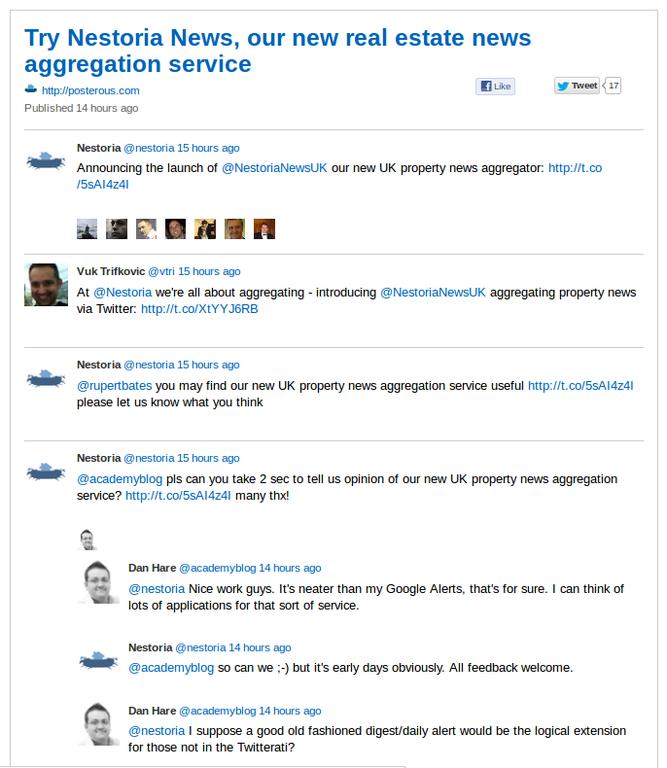
You can follow these services in the web, and also following the Twitter accounts, NestoriaNewsUk and Kisale_es.
I am confident enought that over the following months we'll deploy more of these RobSoC machines. Probably the next one will be in our own language, Basque. We'll see ;-)
Did Basques of the Ice Age travel to settle America?
Ice Age Columbus is a documentary fictionalizing certain theory: that the first settlers of the Americas didn't cross to the continent thru the Beringia connection (land bridge between Siberia and Alaska) but rather directly from Western Europe, following the edge of the ice shelf that covered the North Atlantic (without discounting the Beringian-Asian settlement, this just came afterwards). Some scientists defending this theory appear in the documentary, but it's mostly a recreation with actors (in the BBC they broadcasted it as Stone Age Columbus).

For me, as a Basque, is somehow thrilling (and chauvinistic, perhaps) to think about the idea... The Franco-Cantabrian refuge of the ice age in Western Europe was centered in this country of ours. The humans of the Solutrean carving culture depicted in the movie, painters of caves like Ekain, were living in this very countryside that is our home. And in the documentary, the adventurous tribe depicted gets out to the Atlantic from more or less the Basque Country (the northern tip of it, bordering the Landes region of France).

However, this idea has not many supporters, and the documentary does not check the counter-theories. It presents two things as if they were proven facts:
1. that Solutrean tools identical to the European ones appeared in Virginia (USA) 17,000 years ago (5 millennia before the arrival of other people from Siberia).
2. that traits of ancient European DNA are part of the Amerindian genetic inheritance (mixed with the Asian stock)
Yet, if you consult the Wikipedia, those two points are far from being accepted by the scientific community. Balancing what I have seen and read, it looks improbable to me, this idea of the Inuit-like Basques crossing the Atlantic 17,000 years ago. But it would have been fun and awesome if it were true, wouldn't it?
Basque language at Fry's Planet Word
I've recently watched Stephen Fry's Planet Word, a documentary series of the BBC, which I downloaded from BitTorrent. The wonders of that distintive human trait, language, basis of our culture, civilisation...
It is a very watchable series, well produced and narrated with Fry's usual charm and enthusiasm (he is the writer of the series as well). I found some parts really fascinating as the bit about the girl with Tourette's syndrome who cannot stop from saying expletives, or the musings about poetry and pop-rock lyrics with the author of the script of 4 weddings and a funeral.
However, some scientific aspects of the issue are treated somehow lightly, I guess. And the choice of travels made by Fry to interview and meet people speaking different languages seemed to me to be not too well rehearsed. For instance, I feel honored that Fry talked about Basque, and visited us, my city, Donostia, to be precise. 10 minutes of episode 2 are dedicated to our isolate language, and how it survives despite its minority status. However, the choice of interview to illustrate that point was awful: they spent the day (it seems) in Donostia with a famous Basque cook, Juan Mari Arzak and his daughter, and just spoke with little sense about the relationship between Basque gastronomy, our love for food, and the Basque language and our love for it. That makes no sense at all, and besides, Arzak is a man with very little fluency in Basque, and the mix of Basque, Spanish and French that he produces while speaking with Fry is horrible.

Elena Arzak, Stephen Fry (wiith propaganda of Donostia 2016) and Juan Mari Arzak
The producers could have sent someone more apt to do some research and find more appropiate people in Donostia. For instance, linguist Itziar Laka or the people working at the BCBL center; insightful investigation about language acquistion, bilingualism and the brain's linguistic secrets, which they could have used in other episodes. As for speakers, lots of people, anonymous or distinguished in some filed or other, could have provided a much better chat to Mr. Fry. If the matter was to connect it with food, they could have got better advice and met Hilario Arbelaitz at the Zuberoa restaurant, for instance.
I also felt that some other visits to speakers of some languages were somehow similarly wasted, as with the Turkana in Kenya. Irish also appears, though I'm not sure if it was depicted accurately or erroneously.
Anyway, BBC and Stephen Fry, the effort is appreciated, thanks for putting us Basques in this brilliant television product.