
English-language version of Luistxo Fernandez's blog
Places where it's hip to be square
Luistxo Fernandez
2007/11/23 08:43
The WSJ piece attacking the Basque language has ignited a long tail of reactions. Summarizing: the original article's here, an account of the outrage, some replies are linked in my own post, the WSJ itself published some reply letters, and then there's also a big protest letter signed by 180 personalities.
Well, fortunately, not all foreign accounts about modern Basque living in the international media are so negative. Commonly, it's more about the marvels of Guggenheim (in the New York Times, last september), or delightful gastronomy (just past week in the NYT, again).
My favourite one, however, was written for Slate in 2003. Adventures in Basqueland by June Thomas was a nice piece of reporting, I think. June wrote about what she found amusing, and did so in a descriptive but personal way. This lovely paragraph, for instance:
It's also amusing for us finding that what we might consider standard amuses the foreigner...
Well, fortunately, not all foreign accounts about modern Basque living in the international media are so negative. Commonly, it's more about the marvels of Guggenheim (in the New York Times, last september), or delightful gastronomy (just past week in the NYT, again).
My favourite one, however, was written for Slate in 2003. Adventures in Basqueland by June Thomas was a nice piece of reporting, I think. June wrote about what she found amusing, and did so in a descriptive but personal way. This lovely paragraph, for instance:
Every day, groups performing styles of traditional regional music known as trikitrixa, alboka, and gaita tour the original seven streets of the Casco Viejo. Although some, especially the choral groups, tend to be dominated by graybeards, others are composed of twentysomething scenesters. Here and in the dances of the Basque Country performed every evening in the Plaza Nueva, I was shocked by how hip the artists were. Several of the young women playing medieval music on authentic instruments or dancing a jota had facial piercings; the guys with bells tied round their knees doing the sword dance while wearing big goofy red berets were cool kids with tattoos and novelty sideburns. In the Basque Country these days, it seems, it's hip to be square.
It's also amusing for us finding that what we might consider standard amuses the foreigner...
2 erantzun
The Wall Street Journal says Basque isn't used in real life
Luistxo Fernandez
2007/11/07 09:39
The Wall Street Journal has decided to insult Basque speakers. What a shame of an article. It's hard to be a minority language speaker, precisely when it's minoritised even in your own land... And yet, looks as if Spanish speakers are the ones being persecuted by Inquisition. No. It's Spanish Inquisition the one that in the 21st century decided to close the only Basque-language daily newspaper, based in false accusations. As false as all content in that article.
Of course, the journalist got collaboration from local idiots. "Euskera just isn't used in real life", says a member of the Basque Parliament. If you're reading this here, you may follow the links to my Basque blog, this public discussion about the Guggenheim Bilbao or the Wikipedia. I hope that proves that Basque is at least used in virtual life.

Besides, the news item in the web mentions a correction regarding that map. Spain's Basque Country, at its widest point, spans approximately 85 miles, or 136.8 kilometers. A map that accompanied a previous version of this article had an incorrect scale. I wonder what they showed previously. But masquarading the Basque Country's map as the Hoped-for Basque homeland shows the political intent of the report.
Not all Basque maps published by American media are so deceptive. This map below was published by the National Geographic Magazine in 1997. Well, that's Euskal Herria. And Euskal Herria means (not difficult to grasp) Basque Country = Pays Basque = País Vasco.
Of course, the journalist got collaboration from local idiots. "Euskera just isn't used in real life", says a member of the Basque Parliament. If you're reading this here, you may follow the links to my Basque blog, this public discussion about the Guggenheim Bilbao or the Wikipedia. I hope that proves that Basque is at least used in virtual life.
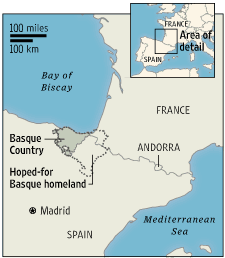
Besides, the news item in the web mentions a correction regarding that map. Spain's Basque Country, at its widest point, spans approximately 85 miles, or 136.8 kilometers. A map that accompanied a previous version of this article had an incorrect scale. I wonder what they showed previously. But masquarading the Basque Country's map as the Hoped-for Basque homeland shows the political intent of the report.
Not all Basque maps published by American media are so deceptive. This map below was published by the National Geographic Magazine in 1997. Well, that's Euskal Herria. And Euskal Herria means (not difficult to grasp) Basque Country = Pays Basque = País Vasco.
