
English-language version of Luistxo Fernandez's blog
Sad Christmas carol (anyway, wishing you all a happy new year)
Imagine the town council of Mobile, Alabama, publishes a web poll in its official website, asking How will you spen the next days? and the options for replying are:
- Christian Christmas
- Hanukkah
- Kwanzaa
- We're atheists, but we enjoy family life watching old Carl Sagan videos.
And then, let's imagine that people come and vote and atheists are winning by an astonishing 85%! Someone reacts in the town council and the poll and its results disappear from the web, due to some technical fixes that must be done.
Well, this Christmas carol actually happened here in the Basque Country. There is some sort of ethnic divide regarding Christmas. For the Spanish, it's the Three Kings that bring the presents. For Basques,
an indigenous figure, Olentzero, a bearded coalmaker from the mountains. There's also Papa Noel, called in the French way, also known as Santa Claus (well, there are also Basque traditions around San Nikolas but that's another story), more marginal in its appeal.
And the town council of Iruñea (Pamplona, the city of the running of the bulls) put a poll on its website, asking for preferences:
- The Kings
- Olentzero
- Santa
Then the results come...

And the radical rightwing Spanish ruling party in the city takes the poll down from the website. Well, we had saved our screenshots, just in case. There's more than that on the issue, cause in the last years the civic
processions of Olentzero coming from the mountains have been banned in Iruñea: fines of several thousand euros have been put to the civil groups that organise them. Olentzero is an outlaw there...
It's a sad story. 2007 has not been a good year in the Basque Country. No much room for hope for 2008, due to the political circumstances. I feel helpless about that, not much can be done personally, I'm afraid. So, let's try to leave our lives modestly, enjoy the innocence of our children, try to be happy in private, with our friends and family. These two are my happiness, Peru and Lili, and in accordance with my blog tradition of publishing the best photo of them both, this is my choice.

Happy 2008 to all. Peace. (there's also a carol sung by the whole family!)
The cemetery's migrating
Google Chart API replaces the Bloglines plumber

It seems the owners of Bloglines, Ask.com, are experimenting with Google Chart API. Those bubbles are Venn diagrams, aren't they? I'm experimenting too. Here's my trial below. Web navigation in the Basque Country by language (source: Eustat). Areas are exact, overlaps between languages just invented, only decorative.

Bloglines is so stalled since Mark Fletcher left it... He's experimenting with other things now: his own DNA (something that interests me as well, btw)
Places where it's hip to be square
Well, fortunately, not all foreign accounts about modern Basque living in the international media are so negative. Commonly, it's more about the marvels of Guggenheim (in the New York Times, last september), or delightful gastronomy (just past week in the NYT, again).
My favourite one, however, was written for Slate in 2003. Adventures in Basqueland by June Thomas was a nice piece of reporting, I think. June wrote about what she found amusing, and did so in a descriptive but personal way. This lovely paragraph, for instance:
Every day, groups performing styles of traditional regional music known as trikitrixa, alboka, and gaita tour the original seven streets of the Casco Viejo. Although some, especially the choral groups, tend to be dominated by graybeards, others are composed of twentysomething scenesters. Here and in the dances of the Basque Country performed every evening in the Plaza Nueva, I was shocked by how hip the artists were. Several of the young women playing medieval music on authentic instruments or dancing a jota had facial piercings; the guys with bells tied round their knees doing the sword dance while wearing big goofy red berets were cool kids with tattoos and novelty sideburns. In the Basque Country these days, it seems, it's hip to be square.
It's also amusing for us finding that what we might consider standard amuses the foreigner...
The Wall Street Journal says Basque isn't used in real life
Of course, the journalist got collaboration from local idiots. "Euskera just isn't used in real life", says a member of the Basque Parliament. If you're reading this here, you may follow the links to my Basque blog, this public discussion about the Guggenheim Bilbao or the Wikipedia. I hope that proves that Basque is at least used in virtual life.
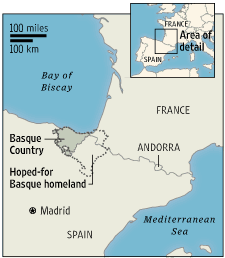
Besides, the news item in the web mentions a correction regarding that map. Spain's Basque Country, at its widest point, spans approximately 85 miles, or 136.8 kilometers. A map that accompanied a previous version of this article had an incorrect scale. I wonder what they showed previously. But masquarading the Basque Country's map as the Hoped-for Basque homeland shows the political intent of the report.
Not all Basque maps published by American media are so deceptive. This map below was published by the National Geographic Magazine in 1997. Well, that's Euskal Herria. And Euskal Herria means (not difficult to grasp) Basque Country = Pays Basque = País Vasco.

Bernardo Atxaga blogs

A little work by the company I work for.
Geodata in Twitter's and Jaiku's APIs

(pic by Miguel Garcia, main organizer of that meetup)
Now that Google bought Jaiku, I feel happy for Jyri, his team and family. I hope this is a opportunity to keep pushing this tool. However, just a reminder. Not only Jyri talked at that Basque meetup, but we at the audience also presented some slides. I talked about Geography in microblogging and presence apps. I guess the slide show is always a insuficient way to substitute the talk, but there it is.
However, I would like to raise a point. Comparing Twitter and Jaiku, and how they present location in their systems and APIs, Jaiku gets the upper hand for now. Location is, for the moment, just a string in Twitter, meaning anything. In Jaiku it's more structured, a triple layer of Country / City / Neighborhood is stored, and when combined with the celltagging capabilities of their Nokia mobile client app, that becomes quite useful to determine location of people in your circle:
<location>
<neighbourhood>Kamppi</neighborhood>
<city>Helsinki</city>
<country>Finland</country>
</location>
That's more structured than Twitter's but, please, Jaikuites, make it a little bit more structured:
<location>
<geo>60.1637687683,24.9310493469</geo>
<neighbourhood>Kamppi</neighborhood>
<city>Helsinki</city>
<country>Finland</country>
</location>
It would be great to interact with that kind of data thru the API, writing and reading. And, certainly, opening the celltagging data would make us salivate even more ;-)
Microsoft software protects cornfield from birds

But in this cornfield in Gaintza, in the Basque Country, the CDs that I found last weekend were particularly interesting: profesional software licensed by Microsoft. Finally, Microsoft's products find a fair and useful application, althought I have doubts if this is legally permitted by the TOS.
This also makes me think about things I've read lately, the momentum of innovation passing from bits to atoms. Well, here we have software being used because of the physical features of its incarnation.
Who will buy OpenStreetMap next?
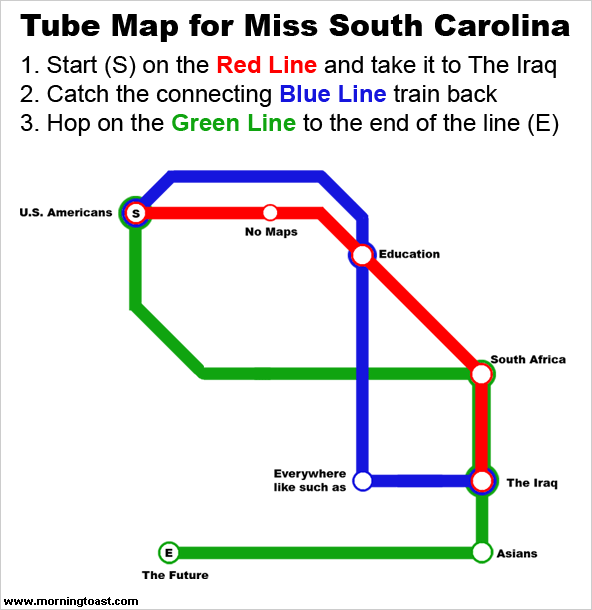
The world needs geography. There's the case of that other TV personality in the US who couldn't tell if the world's flat or not. These two recent gaffes reminded me of another pageant contest in Spain. The Russian ambassador in Spain was part of the jury (hard diplomatic mission, you see) and asked the girl to talk briefly about Russia.
Well, Russia is a country... full of marvelous people... and there's been some political, er, changes, lately, and cannot tell much more.
Monolingual Basques in Ellis Island
Attracted by the story, I researched a little bit more in EllisIsland.org. And I found partial records and names of those monolingual Basqques that arrived in that ship, La Touraine, in March 1911.
It's not easy to search for people arriving on a certain date. You have to search for a name... Try with Bustengorry here.

In the results, the ship manifest lets you see the list of people arriving, but I doubt if you get the whole document or the portion where the given name (Bustengorry in our case) appears. But, well, I found people that arrived that day of march, unnamed in the NYT, but now finally public
- Jean Bustengorry (we would write Buztingorri now, in normalised Basque), from Baigorri
- Jean Etchegarray (Etxegarai), of Banka
- Marie Indiana (probably it's Inda), from Aldude
- Benito Maya (Maia), of Senpere
- and more